In the face of the Chinese, Stellantis is relying on strong technology pooling

With your strategic plan FaSTLAne 2030, Stellantis is carrying out a deep transformation of its industrial and technological organization. Faced with an automotive industry that has become more regional, fragmented and heavily disrupted by the acceleration of software, batteries and artificial intelligence, the manufacturer wants to drastically reduce its technical complexity while accelerating the pace of development.
DuringInvestor Day groups, Antonio Filosa, Ned Curic AND David Mele detailed a strategy based on a global pooling of platforms, engines and software architectures.
” The competitive field is no longer limited to traditional automotive capabilities. Software, artificial intelligence, ADAS and battery technologies are becoming decisive », summed up Antonio Filosa, CEO of Stellantis.
The group plans to invest more than 24 billion euros in its platformsits powertrains and overall technology over the next five years. Within this envelope, Stellantis aims to further pool its developments in order to reduce its industrial costs while increasing its product coverage in major global markets.
This logic of industrial simplification results in a significant reduction in the number of technical bases. ” By 2030, 50% of our annual volumes will be produced on just three global platforms “, explained Antonio Filosa. The manufacturer thus wants to rationalize the historically very fragmented organization between the various brands inherited from PSA and FCA.
The centerpiece of the strategy is the STLA One multi-energy platform
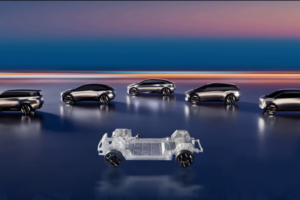
The core of this strategy is STLA onea new architecture to eventually replace the five existing platforms. Developed for segments B, C and D, should make it possible to produce more than thirty models and exceed two million units by 2035. Our ambition is to reduce the number of platforms by approximately half and at the same time to expand regional coverage », explained Davide Mele, Product Planning Manager.
The group says that the STLA One is targeting a profitability of 20%, mainly due to its internal modularity and technological options when it comes to batteries. The architecture must also enable faster development cycles, reduce industrial complexity and improve supply chain stability through strong component standardization.
Stellantis particularly emphasizes the modularity of this architecture. STLA One will be able to accommodate different propulsion units – thermal, hybrid or electric – thanks to common interfaces. ” STLA One perfectly illustrates a true modular strategy that offers us the flexibility of a multi-energy platform without inheriting the inefficiencies associated with adapting one propulsion system to another. », explains Ned Curic, head of product and technology development.

The group also announces up to 70% reuse of components between models and between regions to increase economies of scale and reduce development costs. This strategy should also make it possible to reduce time to market while simplifying industrial operations.
Unlike some manufacturers who have opted for a more radical shift to purely electric propulsion, Stellantis maintains a multi-energy approach. Antonio Filosa recalled that ” electrification continues, but with different technologies depending on the region The group thus intends to simultaneously continue the development of electric vehicles, hybrids, plug-in hybrids, range-extending solutions as well as highly efficient heat engines.
By 2030, almost 50% of the Group’s volumes will use power units common to several regions. At the same time, Stellantis plans to reduce the number of heat engine families by 40% to rationalize its industrial range.
LFP cell-to-body batteries and 800 volt input
The manufacturer also wants to significantly improve the competitiveness of its future electric cars against Chinese concerns. In particular, STLA One will integrate cheaper LFP batteries as well as a cell-to-body architecture where the battery becomes an integral part of the vehicle structure. Stellantis believes that this approach will simultaneously reduce the cost, weight and technical complexity of future electric cars.
” In this way, we intend to reduce the gap in competitiveness with Chinese manufacturers present in Europe “, confirmed Davide Mele. The group is also planning 800-volt architectures to improve the charging time and energy efficiency of future models.
STLA One will also become the first Stellantis platform to be simultaneously integrated STLA brain, STLA SmartCockpit and technology steer-by-wire. This energy strategy also includes increased use of external technology partners. The company Stellantis thus formalized the extension of several structuring collaborations with Qualcomm, Wave AND Applied Intuition. The goal is to speed up the development of software architectures while reducing time to market.
SDV deployment using STLA Brain
In addition to the mechanical platforms, Stellantis is notably overhauling its electronic architecture. With STLA Brain, the group wants to gradually abandon current architectures composed of dozens of independent computers. ” We replace dozens of fragmented systems with a single, intelligent and scalable platform “, explained Ned Curic.
In this SDV strategy, the number of ECUs must be halved, while the on-board computing power is greatly increased. Stellantis also mentions internal bandwidth up to a thousand times greater than current architectures. This new software base should allow for massive OTA updates, adding new features after purchase or even much deeper vehicle customization.
Expansion of partnership with Applied Intuition must accelerate the development of this new architecture. The Californian specialist will work mainly on vehicle operating system, simulation, software verification and autonomous systems. ” Speed, scale and quality are essential to the integration of new technologies into our vehicles » said Ned Curic.
The group also wants to significantly reduce software verification and development cycles using simulation tools and a so-called “AI-native” approach. In particular, applied intuition must contribute to accelerating industrial deployment STLA brain on all group platforms.
Same logic on the side STLA SmartCockpit. Stellantis wants to replace several current infotainment systems with a common platform covering all the group’s brands. ” SmartCockpit now replaces twelve separate systems with a single platform “, said Ned Curic. The manufacturer mentions pooling 85% of the software blocks, leaving brands with the ability to maintain their own digital identity and user experience.
This architecture will rely heavily on platforms Snapdragon digital chassis from Qualcomm. The expanded partnership between the two groups includes the integration of Snapdragon System-on-Chips into future STLA Brain architectures for cockpit power, connectivity and ADAS functionality.
Stellantis thus wants to have uniform computing power throughout the vehicle in order to further standardize its software development. ” Our customers expect next-generation experiences that are seamless and scalable ” explains Ned Curic.
Artificial intelligence is also becoming central to the group’s strategy. Multilingual voice assistant, automatic adaptation of the interface, adaptation to driving habits or permanent updates: Stellantis wants to gradually develop the vehicle towards a logic close to the logic of consumer electronics products.
Automated driving with STLA AutoDrive
The group is also trying to significantly speed up the development of its driver assistance systems. STLA AutoDrive should make it possible to reduce the cost of its future ADAS systems by 70% while increasing their capacity. In this area, Stellantis has just formalized a strategic partnership Wave in order to integrate technology Waveve AI driver to the STLA AutoDrive platform.
The first expected product will be based on Level 2++ door-to-door automated driving, both in urban environments and on highways.. Its launch is planned in North America from 2028. The group specifies that this architecture must then be able to evolve towards higher levels of automation according to regulatory and technological developments.
In particular, Wayve will bring its end-to-end artificial intelligence driving approach, capable of learning from real driving data and adapting to different countries and vehicle types. Stellantis insists on the speed of integration of the first experiments: a working prototype would be developed in less than two months.
Artificial intelligence is also finally becoming a tool for industrial optimization and development. ” Chinese manufacturers are now setting the benchmark for development speed “, admitted Ned Curic. To close the gap, Stellantis says it has already deployed more than 120 AI applications in its operations. The group now uses AI to accelerate simulations, generate software code, optimize designs and pool technical expertise. Some simulations would now be up to 300 times faster.
This transformation should also make it possible to significantly reduce development time. ” We break down the barriers between engineering, design, purchasing and manufacturing ” explains Ned Curic. Stellantis now focuses on complete development cycles of approximately twenty-four months, compared to today’s nearly four years.
Behind this technological reorganization, the group is primarily trying to regain the margins of competitiveness in the automotive industry, where control over software, electronics and development costs is now becoming as decisive as mechanical performance itself. ” We simplify where global scale really matters and differentiate where customers value it Davide Mele summarizes