In Stellantis winning brands…. and defeated


You don’t kill a brand in cold blood. The price to pay is too high, financially, but also symbolically and politically. Antonio Filosa therefore preferred to avoid adding that kind of trauma to the dangerous rescue plan undertaken by the rope group. Forced to increase its alliances with Chinese manufacturers and open itself to suspicion of compromising its identity, Stellantis was not about to leave some family jewels out in the open, even if they were less polished than in the past. At least in appearance…
The group therefore avoided Italian, French or Anglo-German psychodramas by keeping the weak links that are Alfa Romeo, Maserati, Lancia, DS or Opel-Vauxhall. The fact remains that in Auburn Hills, as in Poissy and Turin, everyone understood that fourteen marks was too many. Especially for a group that lost 22 billion euros last year. Antonio Filosa therefore decided to bypass the obstacle. Appearances are maintained, but not all Stellantis brands will be on the same boat.
Three divisions
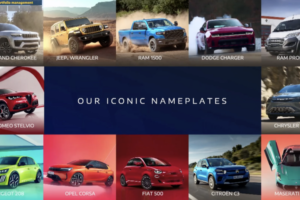
There are now three divisions in the Stellantis Championship. In the first are Jeep and Dodge-Ram, champions of profitability, especially after President Trump returned the thermal engine to the open bar. While North America, which generates 40% of the group’s turnover and will receive 60% of the investment volume planned for 2030, these brands are being asked to become “ATMs” again.
On the other side of the Atlantic stands Fiat, which has lost its foothold in the European market, but has a strong position in South America (and above all embodies the Agnelli family), as well as Peugeot. Five new models are planned for Fiat, while the Sochaux brand, which enjoys a good image and a well-defined identity, will be enriched with four new models. The four flagship brands alone will account for 70% of the investments planned by 2030.
DS and Lancia in a dead end
In the second division are ex-stars of the sixties, whose image is tarnished. Their catalog will expand, but in smaller proportions. Alfa Romeo, whose multiple attempts to relaunch the market have had no effect, will introduce a new SUV and a sports model, while Opel, which is trying to recover, will launch four new products. Repositioned with encouraging results as an “affordable” brand, Citroën will be eligible for three new models, including an electric car for under €15,000 in the form of a reinterpretation of the 2CV. These brands will develop their models in the shadow of big names and their sphere of influence will be limited to certain niches and “regional” markets.
Finally, a third distribution appears, that of breakeven manufacturers whose sales are not declining. In short, those who are most at risk. The Stellantis include Lancia, which will be placed under the supervision of Fiat, and DS, which will join Citroën after twelve years of autonomy. So Lancia and DS will not formally disappear, but we can seriously doubt their sustainability. There is no product plan associated with them, which we agree is a very bad sign. On the other hand, Chrysler, but also Maserati, which we know is in a bad state, will be able to renew part of its offer: three more models for the former, two for the latter.
Cut to it
Arranging the catalog in this way also implicitly determines the brands from which the group could possibly branch out, but this portfolio hierarchy also introduces a multi-speed group. For non-priority manufacturers, there is a risk of more or less rapid downgrading. If Stellantis doesn’t return to fortune quickly, the issue of brand counts and the burden of “dead weight” will return to the fore with greater urgency.
By choosing not to keep all of his parts, but to build them up, Stellantis no doubt judged that each day was enough for his efforts, and that given the magnitude of the task, it was urgent to wait. In other words, Stellantis preferred to keep his decision. With the risk that by 2030 we will have to intervene in a much more brutal way.